Saga
DURATION
January - May 2025
PROJECT TYPE
Thesis Project, VG Lab
MY ROLE
UX-designer & Scrum Master
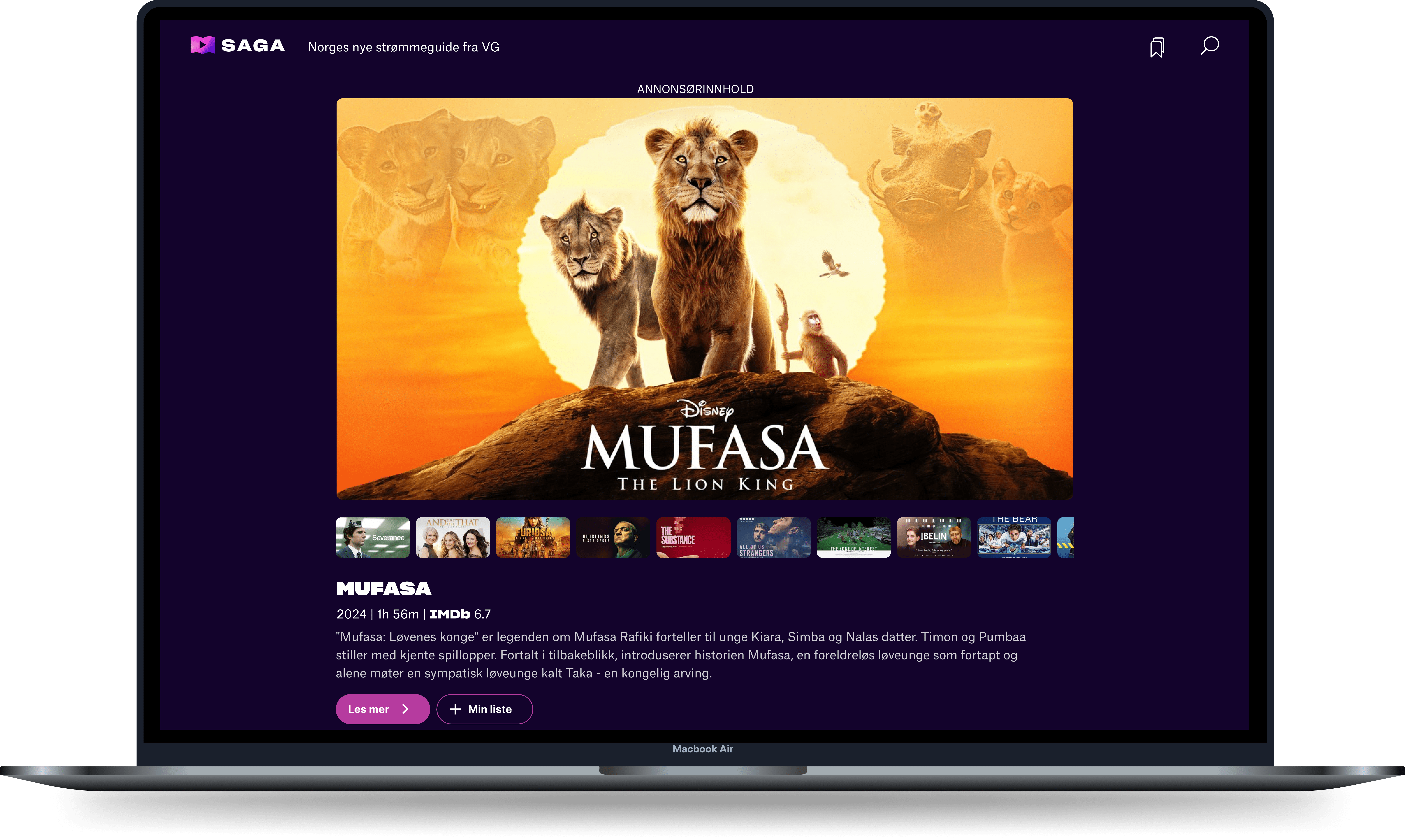
Background
VG Lab, VG's internal innovation unit, brought us in to redesign Saga for a new generation of users. Saga helps people discover content across streaming services — but its existing audience skewed older, and 25–34 year olds weren't engaging.
The challenge was not to build something from scratch. It was to understand why the existing product wasn't resonating, and fix it. I took on a dual role: product designer and Scrum master, responsible for both the design direction and keeping the team aligned across a five-month sprint cycle.
Discover & Define
Phase 1: Understanding the audience
We mapped streaming habits through surveys, in-depth interviews, and a competitive analysis, then used these insights as the foundation for a Value Proposition workshop with VG Lab.
The most revealing finding: users didn't struggle to find content — they struggled to decide. In a fragmented streaming landscape with too many options across too many services, the real problem was decision fatigue, not discovery.
This reframed our entire design direction. Saga didn't need more content — it needed to make choosing feel easier and more human.
What users actually wanted:
Recommendations based on mood and atmosphere, not just genre
Less choice stress in an overwhelming streaming market
A more human voice in recommendations — not just algorithms
Control over which services to filter by — personalisation over completeness


Develop & Deliver
I moved quickly from rough sketches to interactive Figma prototypes, running multiple rounds of user testing along the way. Each iteration was driven by what we heard from users — not by gut feeling. Below are the five features that came out of this process.
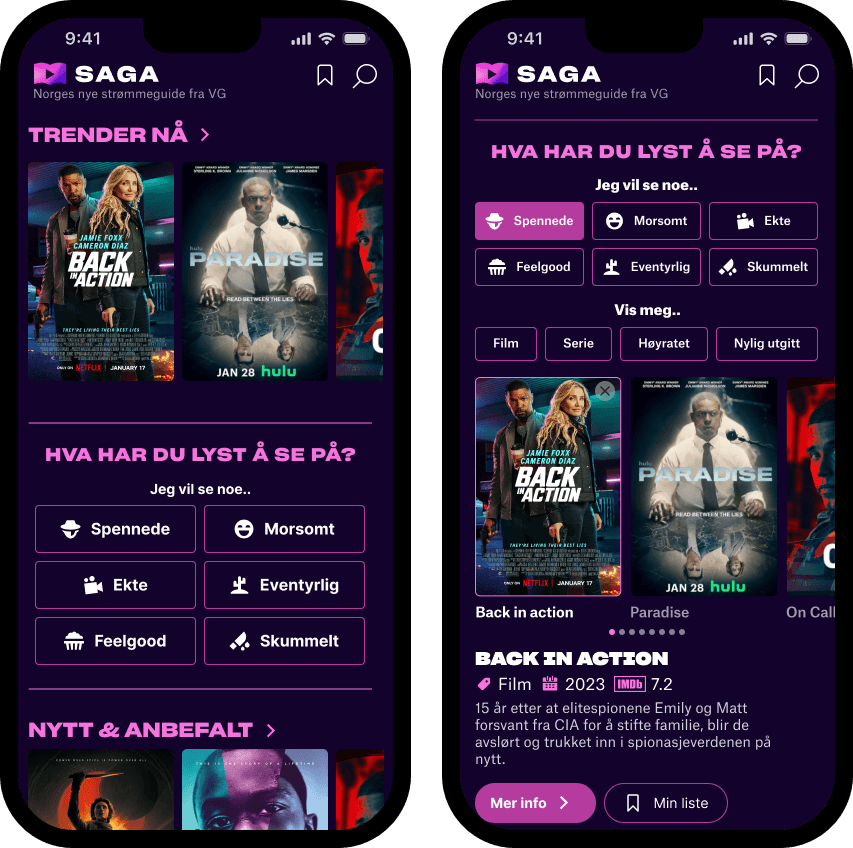
Feature 1 — Jukebox: mood-based recommendations
The research was clear: users wanted content that matched how they felt, not just a genre label. Existing filters — action, drama, comedy — don't capture the nuance of "something cosy for a Sunday evening" or "something intense but not too heavy."
Jukebox lets users select a mood and surfaces matching titles from Saga's API. The design challenge was making mood selection feel expressive and fast — not like yet another filter interface. It was built mobile-first and tested through several iterations before landing on its final form.
Feature 2 — Editorial reviews: a human voice in recommendations
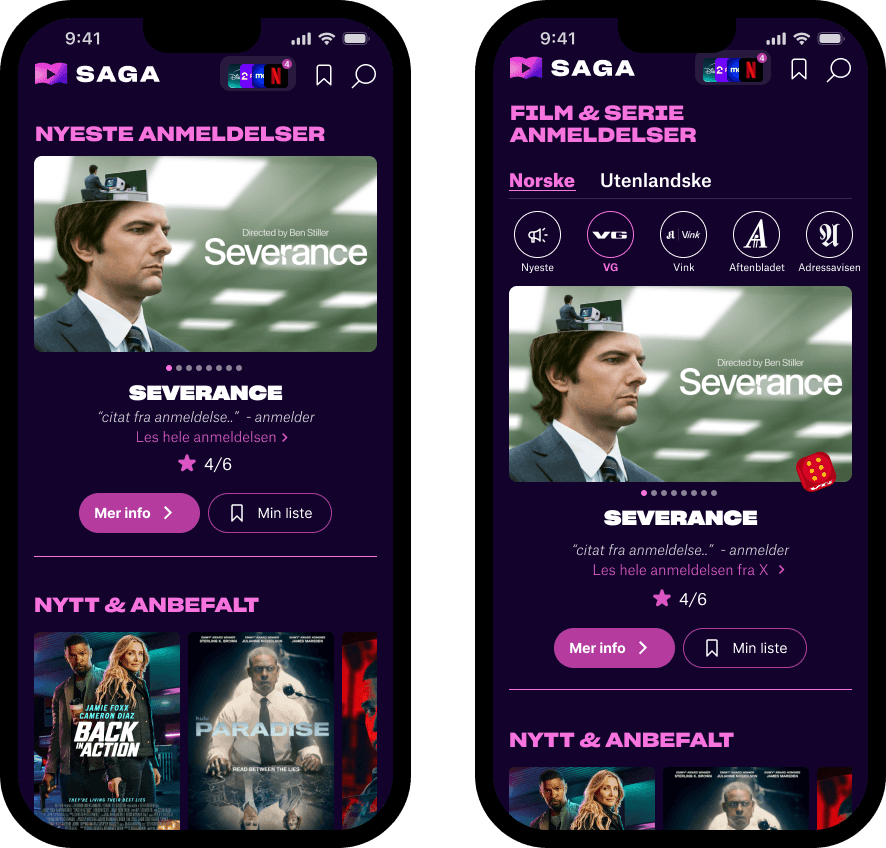
One of the clearest signals from research: algorithmic recommendations felt impersonal. Users trusted recommendations more when they came from a known voice — a critic, a publication, a familiar name.
The review component surfaces editorial ratings from Norwegian and international media, with the option to add content directly to "My Content." It appears in a condensed version on the landing page, and a full view with sorting by source type.

Feature 3 — Search: supporting both intent and exploration
The existing search was functional but invisible. We made it more prominent and extended it to support two distinct use cases: users who know exactly what they're looking for, and users who are still browsing.
The updated search shows popular queries and recently visited titles — so even without a specific title in mind, the search field becomes a starting point for discovery rather than a dead end.
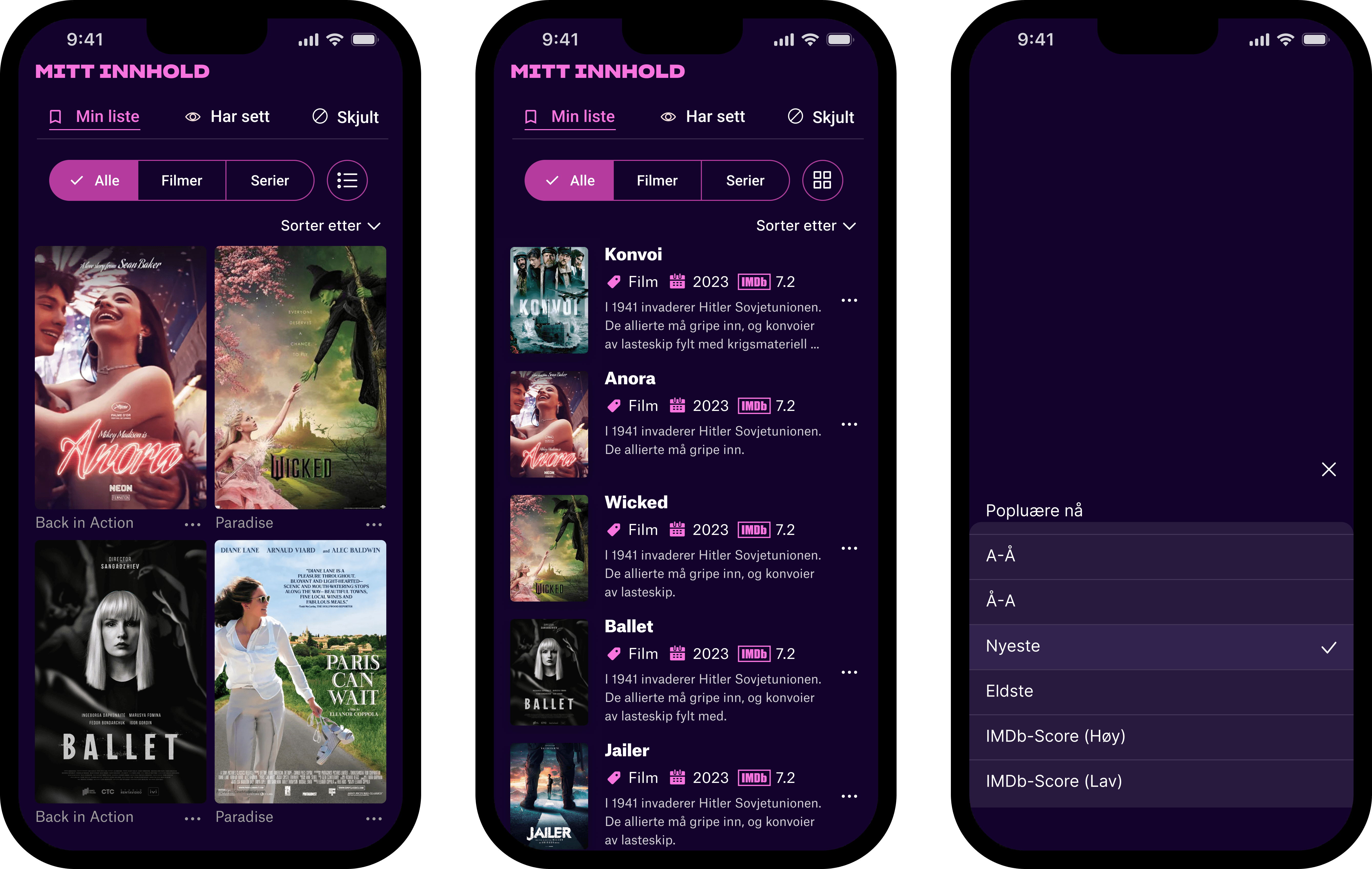
Feature 04 — My Content
My content gives users a personal library of saved, hidden, and watched titles — with clear tabs, flexible sorting, and film/series filtering. It addresses a consistent pain point from testing: "I saved something ages ago and now can't find it."
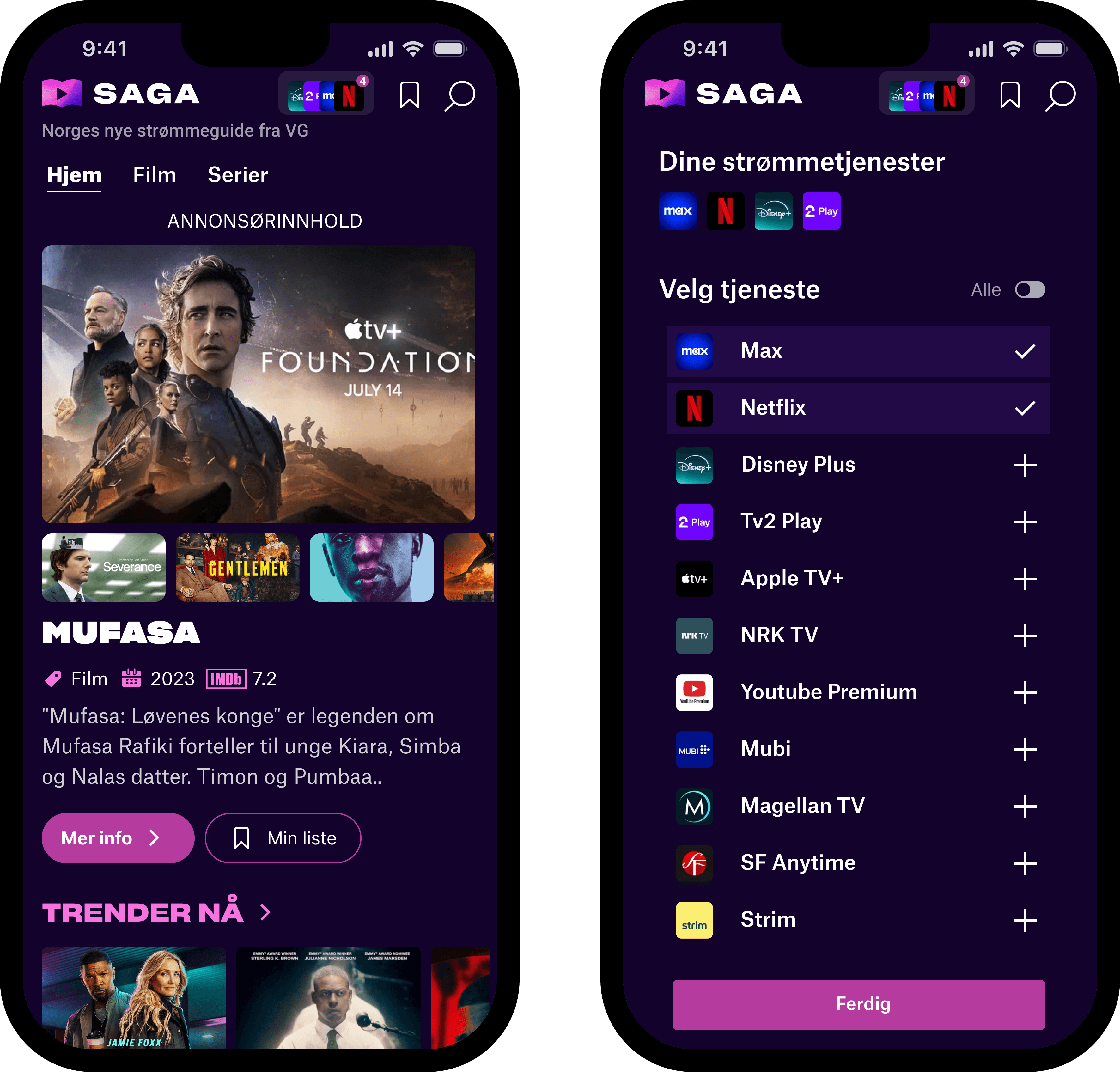
Feature 05 — Streaming service selection
Streaming service selection lets users specify which services they actually subscribe to, so Saga filters out unavailable content. A simple feature — but one that fundamentally changes how relevant every recommendation feels.
Result
After launch, weekly users grew from approximately 4 000 to over 70 000 — a 17× increase that validated the design decisions had real impact beyond the testing environment.
User testing confirmed the redesigned solution felt more intuitive and inspiring, giving the target audience greater control and easier access to relevant content.
What I took away
The problem behind the problem We started this project thinking the challenge was content discovery — helping users find what to watch. The research showed us the real problem was decision fatigue. That shift changed everything: instead of designing features that surface more content, we designed features that reduce friction in choosing. Jukebox is the clearest example — it came directly from reframing the problem.
Running a team, not just a design process Taking on the Scrum master role alongside design taught me something I couldn't have learned in a pure design role: the cost of misalignment is paid in design quality. When the team wasn't clear on priorities, it showed up in the prototype. I got much better at making decisions explicit early — not to control the process, but to protect what we were building.